From the "Water Pump Miracle" to Systemic Advocacy: How Helen Keller Redefined Educational Accessibility
Helen Keller is remembered not merely as a "miracle" who overcame deafness and blindness, but as an outstanding human rights advocate who fought for educational accessibility, women's rights, and social justice.
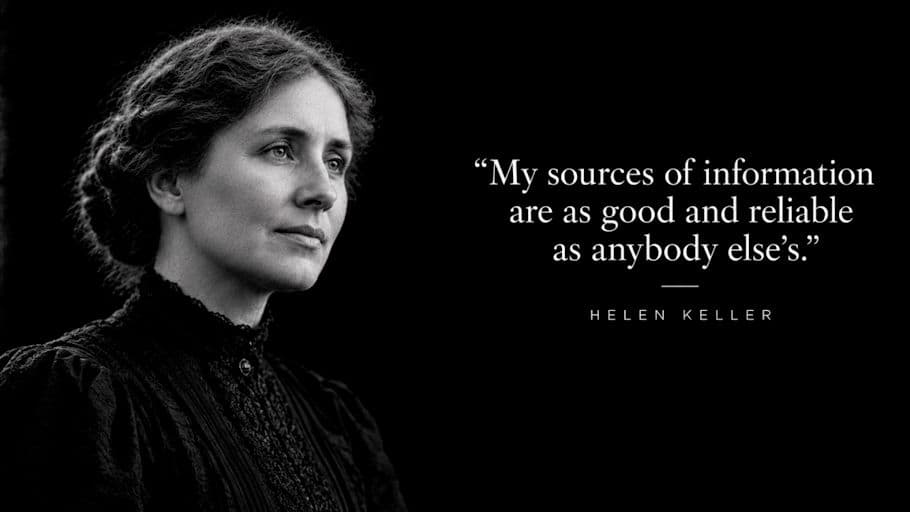
Modern research into Helen Keller's biography indicates that her academic achievements were driven not only by personal resilience but also by the creation of systems for language access that compensated for the total lack of adapted educational materials.
This story teaches us to clearly distinguish between a person's actual cognitive abilities and artificial environmental barriers, reminding us that true inclusion begins where society takes responsibility for providing equal conditions for accessing information.
The paradox of Helen Keller's public memory lies in the fact that society has frozen on the episode at the water pump in 1887, completely ignoring her adult life, which was filled with radical political activism and intellectual independence.
Before her teacher Anne Sullivan arrived, young Helen already used dozens of her own gestures to communicate. Her famous "breakthrough" was the result of weeks of hard work on tactile language perception, not an instant magical miracle. However, the key lesson of her biography lies not in the fact of learning itself, but in the systemic barriers she faced at every step.
Upon entering the prestigious Radcliffe College, Keller found that none of the required textbooks were available in braille. Her instructor was forced to manually spell out texts into her palm for hours on end, causing serious damage to the teacher's own eyesight. This historical fact clearly demonstrates that personal effort and a teacher's dedication cannot and should not substitute for the lack of basic accessible infrastructure, such as adapted books or fair examination conditions.
Adult Helen Keller used her acquired access to information not to be a convenient and grateful "inspiring" figure, but to actively fight for the rights of marginalized groups. She joined the Socialist Party, advocated for women's suffrage, criticized militarism, and demanded fair working conditions for laborers. As soon as her political views became inconvenient for the establishment, the same newspapers that had previously admired her intellect began dismissing her judgments as a result of her disability, claiming she was being manipulated by others. This shift vividly illustrates a dangerous stereotype: society is willing to applaud a person with a disability for their mere existence or basic achievements, but refuses to recognize them as a full-fledged agent capable of forming and defending independent, critical views on how the world works.
The concept modern researchers call "anti-coaching" works flawlessly in Keller's case, separating a person's internal ability to understand information from external conditions of access to it. If a student cannot read an exam paper due to an unfamiliar braille font or a lack of time for tactile perception, this is a problem with the assessment format, not with their intelligence.
Keller's history requires us to stop demanding superhuman efforts from people with disabilities to overcome artificially created barriers. Instead, the focus must shift to creating reliable accessibility infrastructure: from tactile displays and personal assistant services to flexible testing formats that assess actual knowledge rather than the speed of decoding an inaccessible format.
Who is affected
Люди с ограниченными возможностями не должны доказывать свою гениальность или исключительную стойкость, чтобы заслужить право на адаптированные учебники, сурдоперевод, тифлокомментирование или дополнительное время на экзамене.