Cataracts altered Claude Monet's color perception and influenced his late works
How cataracts reshaped Monet's palette: a medical perspective on his late masterpieces
How cataracts reshaped Monet's palette: a medical perspective on his late masterpieces
In 1912, Claude Monet was diagnosed with cataracts, which fundamentally altered his color perception at the twilight of his career. Despite undergoing surgery on his right eye in early 1923, the master faced unpredictable spectral distortions, forcing him to rely on muscle memory and factory pigment labels. A study of ophthalmological models and archival data demonstrates how this subtle visual transformation turned basic artistic control into a continuous professional challenge, leaving its mark on the creation of the famous 'Water Lilies'.
The Physiology of a Fading Spectrum
Nuclear cataracts gradually thicken and yellow the lens, cutting off short-wavelength radiation. The retina is deprived of some blue and violet light, causing the surrounding world to appear dull and shifted toward a warmer palette. Monet openly complained to those around him that familiar colors had lost their former saturation and intensity for him. This condition is particularly insidious for artists, as it destroys the very instrument of self-verification.
The Anatomy of Artistic Doubt
The traditional process of painting requires constant comparison: a brushstroke is applied, evaluated, and adjusted. With progressive lens opacity, a second look brings no clarity, as the distortion is fixed at the level of the sensory organ itself. Monet's situation was fundamentally different from Beethoven's deafness, which completely deprived him of acoustic feedback. The French painter continued to receive visual information but lost the ability to reliably differentiate its nuances.
Relying on Habits and External Markers
To compensate for the unreliability of his visual judgments, the artist began to rely on the labels on his paint tubes and years of muscle memory. However, a pigment's name does not guarantee predictable behavior on the canvas once mixed. Research by Michael Marmor and James Ravin confirms that an external identifier helps in selecting materials but cannot replace the final visual assessment, which is inevitably refracted through the affected eye.
Evidence from the Canvas and Medical Simulations
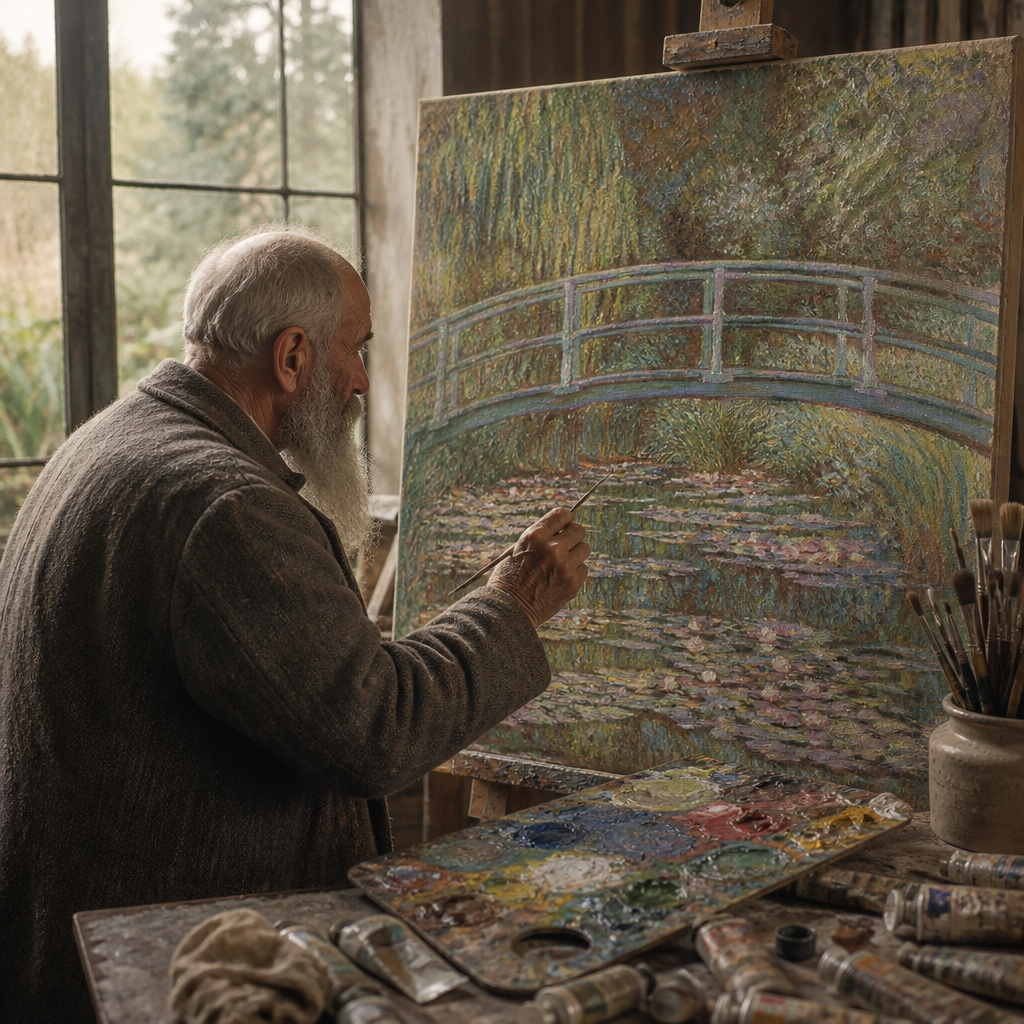
Art historians note that the painting 'The Japanese Footbridge' from the MoMA collection, created between 1920 and 1922, is characterized by a dense texture and a dominance of terracotta, rust, and maroon tones. A direct interpretation of these facts as purely a medical symptom would be a mistake, as a canvas cannot serve as a clinical instrument. Ophthalmological simulations only model the likely blurring and yellowing, but do not reveal the artist's internal creative compromises.
Surgical Intervention and New Challenges
For a long time, Monet avoided surgery, fearing irreversible consequences for his craft. In 1922, Dr. Charles Coutela prescribed dilating drops, providing temporary relief. The cataract on his right eye was not removed until January 1923. The left eye remained unoperated. After the procedure, the master required specialized glasses, and the world appeared to him with an intrusive blue tint, necessitating a long and agonizing adaptation.
Epidemiology and the Evolution of Treatment
The vision problems faced by the genius remain a widespread phenomenon: by the age of eighty, more than half of Americans develop cataracts or undergo cataract removal. While in the 1920s the lens was simply extracted, forcing patients to wear thick lenses, after 1949, thanks to the Briton Harold Ridley, replacement with an artificial implant became standard practice. Early signs of the condition include cloudy vision, fading colors, and halos around lights, with diagnosis confirmed by a dilated eye exam.
The monumental 'Water Lilies' panels, unveiled to the public at the Orangerie in 1927, were the culmination of colossal work carried out under conditions of changing perception. Claude Monet died in Giverny in December 1926, never seeing the final exhibition. His late period proves that clinical improvement in eye condition and the ability to flawlessly execute one's work are two different categories. Maintaining professional activity does not negate physiological limitations, but rather underscores the scale of the adaptation the master undertook to complete his ultimate visual legacy.
Who is affected
Некеоторые музеи адаптируют экспозиции поздних работ Моне для посетителей с нарушениями цветовосприятия.