Not seeing the finish line to cross it: How an elite athlete with Stargardt disease redefined the rules of the game
The story of Paralympic and Olympic champion Marla Runyan proves that "legal blindness" is not a sentence, but a specific set of conditions requiring a unique strategy.
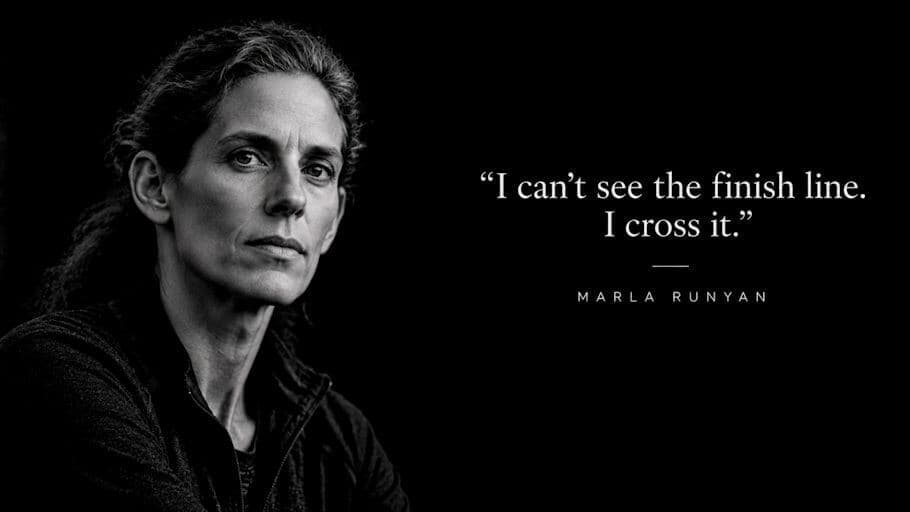
Marla Runyan entered sports history as a unique figure who achieved the highest results at both the Paralympic and Olympic Games.
At the age of nine, she was diagnosed with Stargardt disease-the most common form of juvenile macular degeneration. This genetic condition gradually destroys central vision, which is necessary for reading, recognizing faces, and assessing fine details, while typically preserving peripheral vision. For a runner, this meant she could clearly see the track surface, movement, and colors around her, but numbers on a stopwatch, bib numbers on competitors' backs, and the finish line itself often dissolved into the blind spot in her field of view.
This condition differs fundamentally from total blindness or running in the dark. The field of view existed, but access to information within it was extremely uneven. At the elite level of middle- and long-distance running, athletes constantly assess their position, speed, collision risks, and competitors' actions. Runyan was forced to navigate this complex system by relying not on traditional visual markers, but on alternative channels of perception. She learned to read the mechanics of runners beside her, orient herself by the sound of their breathing, and perfectly sense the rhythm of her own body.
This approach formed the basis of what the article's author calls the concept of "anti-coaching." Instead of trying to compensate for the lack of vision through excessive effort or pretending the limitation had disappeared, Runyan clearly separated the information she could rely on from what she simply did not have. In hurdle races, she developed a strict rhythm of eight steps to the first barrier and three between the others, turning a visual task into one of muscle memory and timing. At the New York City Marathon, where conditions were constantly changing, she used the help of a cyclist who relayed split times and warned her about turns, while a separate women's start allowed her to simply count participants in her group to assess her position.
Runyan is often mistakenly described as having followed a linear path from the Paralympics to the Olympics, implying that one was merely preparation for the other. However, her achievements refute this hierarchy. After winning numerous gold medals at the Paralympics in Barcelona and Atlanta across various disciplines, she later reached the final of the Olympic 1500-meter race in Sydney. This proves that her athletic intelligence, physical conditioning, and adaptive skills remained consistently high; only the classification system and the surrounding rules changed. The term "legally blind" was medically accurate, but it proved too blunt an instrument to describe exactly how she perceived the world at high speed and how effectively she managed the data available to her.
As the athlete herself noted in her memoirs: "I don't see the finish line. I cross it."
This phrase perfectly illustrates the essence of her method. Missing information is not recreated by willpower; it is compensated for by restructuring actions around what remains. This principle extends far beyond major sports. People with macular degeneration, glaucoma, or other forms of central vision loss face similar challenges daily at crosswalks, in stores, or in the workplace. Success in these situations depends on the same skill: the ability to accurately determine which signals can be trusted and when it is necessary to rely on external assistance or specialized technical aids.
Who is affected
Для тренеров, работодателей и членов семей людей с нарушениями зрения этот опыт несет важнейший практический урок. Поддержка человека со слабым зрением должна начинаться не с абстрактных предположений о том, что такое «слепота», и не с ожидания, что человек будет функционировать так же, как видящий.