Inclusion in Rwanda: How Local Traditions and Global Standards Shape an Accessible Environment
The Evolution of Inclusion: From Rwandan Legends to Modern Universities
The Evolution of Inclusion: From Rwandan Legends to Modern Universities
For over three decades, Evariste Karangwa, who served as Dean of the School of Inclusive Education at the University of Rwanda from 2014 to 2024, has dedicated himself to developing an accessible environment in his country. His journey reflects the complex transformation of attitudes toward people with disabilities: from colonial segregation and post-war enthusiasm to the integration of ancient community traditions with global human rights standards. Today, Rwandan society, drawing on its unique historical experience, continues to rethink the role of vulnerable groups despite new challenges, as evidenced by materials from Debrief, prepared with the participation of illustrator Kinanti Andini and editor Peter Torres Fremlyn.
Colonial Legacy and First Steps: Before gaining independence, Rwanda was under German rule (1885–1916) and then Belgian rule (1916–1962). Colonial administrations paid virtually no attention to disability issues. The situation began to change in 1962 when Belgian priest Joseph Fraipont (1919–1982) founded the HVP center in Gatagara. For over forty years, this organization remained the only institution providing education and rehabilitation for children with physical and sensory impairments.
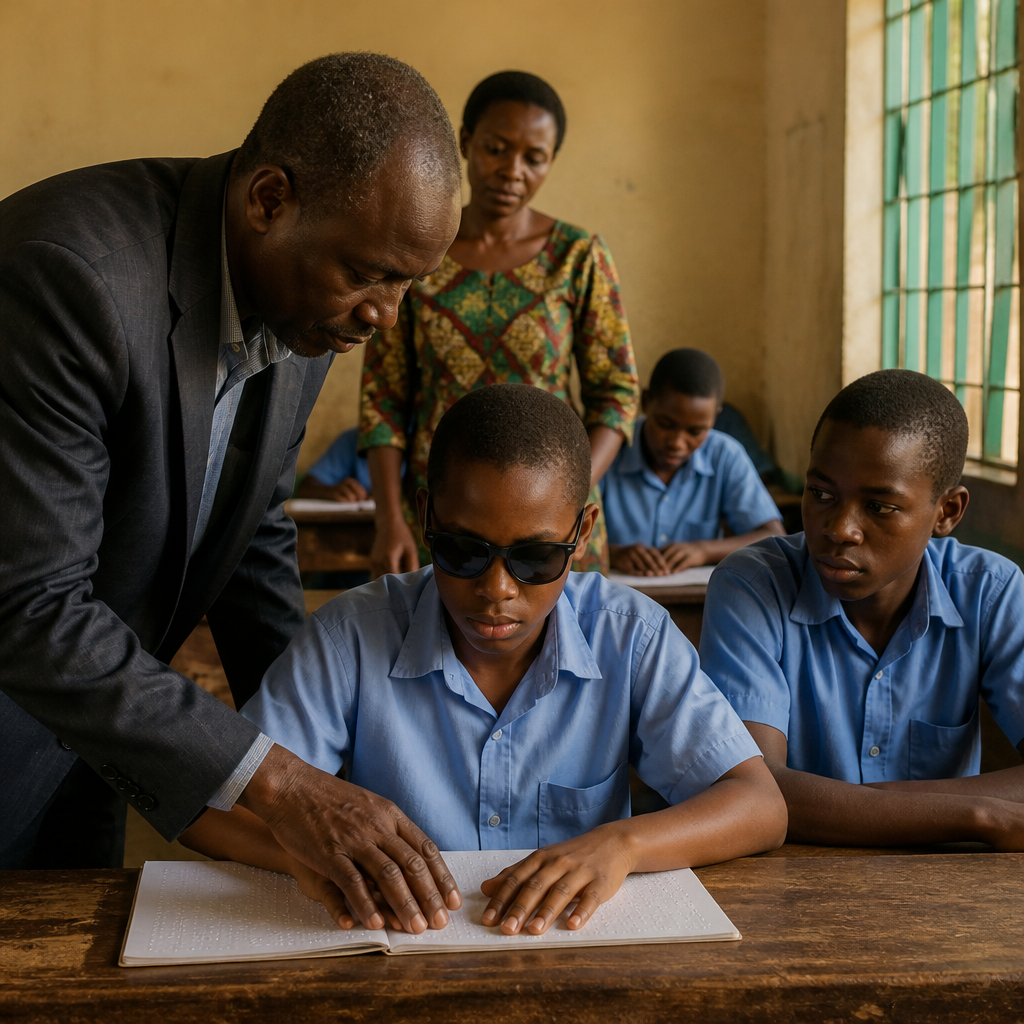
Post-War Revival and the First Inclusive Classrooms: Seven months after the 1994 genocide, the author was assigned to rebuild Gahini Secondary School, founded in the 1960s by Anglican missionaries. The institution lay in ruins: there were no door handles, electricity, or water, furniture had been burned by refugees, and only three staff members returned. The first 91 students were in shock. Soon, a group of Rwandan educators with disabilities, referred by a Rwandan Patriotic Front soldier, approached the school. These specialists had been unable to receive an education in their homeland in their youth and were taken by missionaries to Kenya. They strongly recommended admitting children with visual impairments. The author's wife, Mary, reminded him of the positive experience of inclusive education at St. Helena School in Mbarara, Uganda, prompting him to seek the support of the Minister of Education. On February 11, 1997, eight blind students (four boys and four girls) enrolled in the school. Funds from parents and the tradition of 'umuganda'-a practice of mutual assistance-were used to create a resource room. Subsequently, the number of students with disabilities grew to 33.
Memory of the Genocide and Ambivalent Societal Attitudes: During events commemorating the victims of the genocide, a telling incident occurred at the University of Rwanda. One of the students with disabilities asked about the fate of people with developmental disabilities during those tragic events. The speaker could not provide an answer, which sparked a heated discussion. It turned out that the attitude of the Interahamwe militants toward victims with disabilities was ambiguous. On the one hand, some government soldiers with health impairments took out their despair on patients at the Brothers of Charity center. On the other hand, the superstitious beliefs of the militia sometimes saved the lives of vulnerable people: there were beliefs that such people were already 'half dead,' that only 'normal' people were killed, and that harming a person with a disability would bring a curse, causing the offender's wife to give birth to a similar child.
Ancient Traditions and Linguistic Stereotypes: In the pre-colonial period, people with disabilities often held a respected place in society. Rwandan folklore has preserved the memory of Runukamisho rwa Muhiga rwa Nyamurorwa, a blind advisor to King Mimambwe I (15th century), as well as King Yuhi III (1735–1766), who suffered from mental disorders but was renowned as a wise poet. In the 18th century, Rwugamo lived, whose eloquence gave rise to the proverb 'Umusazi arasara akagwa kw'ijambo,' meaning that madness can lead to wisdom. However, Mary rightly noted that female figures with disabilities are practically absent from these legends. Linguistic norms also reflect historical stigmatization. In Bantu languages, prefixes characteristic of inanimate objects are often used to refer to people with disabilities: the Kinyarwanda 'ikimuga' (broken object) and 'akaragi' (mute little creature), Swahili 'kipofu', and Luganda 'akasilu'. Activist organizations issue 'say this, not that' guidelines to monitor the use of inappropriate terms. Nevertheless, Giorgio Brocco's research in Tanzania shows that the perception of such terms by people with albinism depends on the attitude of those around them, not just the words themselves, as it is customary in African communities to refer to people by their physical characteristics.
Modern Challenges and Global Standards: Despite thirty years of progress, inclusive education faces difficulties. It was recently reported that inclusive programs at Gahini School were closed, which was met with irony by Venny (pseudonym), one of the first eight blind graduates, who now works in a government department. At the same time, at the national level, the HVP center has expanded its network to six branches. Studies of African norms show that pre-colonial perspectives were contextual: as noted by Alexandra Morris (Ancient Egypt), Edwin Etieyibo and Odirin Omigbe (Nigeria), and Nelly Mwale (Chewa society in Zambia), stigma coexisted with community care. The author notes that modern reforms are often dictated by the requirements of international organizations that ignore local potential. The exceptions are only those initiatives that unite the efforts of schools and parents with the support of readers, including a new contribution from Andrew.
Evariste Karangwa's thirty-year journey demonstrates how deeply ancient cultural attitudes, colonial legacy, and modern human rights approaches are intertwined in Rwanda. Building an inclusive environment requires not just copying foreign models, but also carefully utilizing the internal resources of society. The history of inclusion in Rwanda proves that true integration is possible only with respect for local traditions and the active participation of people with disabilities themselves, who today not only receive an education but also shape policy in this area, sharing their unique experience with colleagues around the world through a newsletter covering news from over 170 countries.
Who is affected
Материал напрямую касается эволюции инклюзивного образования и отношения к людям с инвалидностью в Руанде. Поднимаются вопросы языковой стигматизации и влияния культурных традиций. Ключевым негативным фактором выступает закрытие инклюзивных программ в школе Гахини, что создает прямую угрозу доступности образования для студентов с инвалидностью и демонстрирует уязвимость инклюзивных инициатив перед лицом институциональных изменений. Кого затрагивает: люди с инвалидностью, люди с нарушениями зрения, люди с психосоциальными нарушениями, образовательные учреждения, родители и семьи.
Закрытие инклюзивных программ в школе Гахини создает прямой барьер для доступа к образованию незрячих студентов. Необходима адаптация учебных материалов и среды с учетом потребностей студентов с сенсорными и физическими нарушениями. Важно учитывать языковые барьеры и стигматизирующую терминологию при общении и создании инклюзивной среды. При внедрении глобальных стандартов инклюзии следует опираться на местные общинные ресурсы и традиции взаимопомощи.